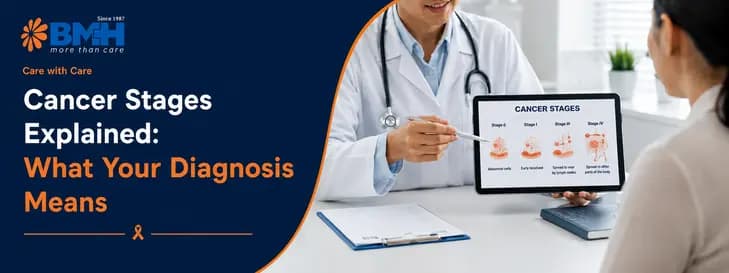

Hearing the word "cancer" is hard enough. Hearing "Stage 2" or "Stage 4" right after it, without anyone pausing to explain what that number actually means, is harder still. Most patients leave that first consultation with a diagnosis and a stage number, but very little understanding of what either really implies for their treatment or their life.
Cancer staging is a standardized way doctors describe how far cancer has spread in your body, and it plays a crucial role in planning your treatment.
This guide breaks down cancer staging in plain language: what the stage numbers mean, how doctors arrive at them, why the process matters so much for treatment planning, and what the picture looks like specifically for patients in Kerala, across India, and for Gulf-based Indian families navigating a diagnosis from abroad.
What Does Cancer Staging Mean?
Cancer staging is a system doctors use to describe the extent of cancer in your body at the time of diagnosis. Think of it as a way of measuring how serious the cancer is and where it has spread.
Staging helps your medical team decide on the best treatment options, predict how the cancer might behave, and give you realistic information about your prognosis, the likely outcome of your disease.
Staging isn't just about size. It considers whether cancer is confined to one spot, has grown into nearby tissues, or has spread to distant parts of your body. The stage you're assigned becomes part of your permanent medical record and helps doctors communicate clearly about your condition.
It also allows researchers to compare outcomes across different patients and improve treatment protocols over time. Your cancer stage may be re-evaluated after treatment begins, especially if your condition changes.
Stage vs Grade; the Distinction Most Patients Miss Patients often confuse "stage" with "grade," but they answer two different questions:
- Stage answers: How far has the cancer spread? (size, node involvement, metastasis)
- Grade answers: How abnormal do the cancer cells look under a microscope, and how fast are they likely to grow?
A tumour can be small (early stage) but high-grade (aggressive-looking cells), or larger (later stage) but low-grade (slow-growing). Your treatment plan is built by looking at stage and grade together, not either one in isolation.
The TNM Staging System Explained
Most solid tumors (cancers that form lumps) are staged using the TNM system, developed by the American Joint Committee on Cancer. TNM stands for three key factors that define your cancer. Understanding each letter helps you grasp how your stage was determined.
It breaks the disease down into three measurements:
| Letter | What It Measures | Typical Range |
|---|---|---|
| T – Tumour | Size and local extent of the primary tumour | T0 (no evidence) to T4 (large/deeply invasive) |
| N – Nodes | Whether nearby lymph nodes are involved | N0 (none) to N3 (extensive) |
| M – Metastasis | Whether cancer has spread to distant organs | M0 (no spread) or M1 (distant spread present) |
Once a tumour is scored on all three (for example, T2 N1 M0), oncologists group that combination into one overall stage, 0 through IV. This grouping is what your discharge summary or pathology report usually refers to when it says "Stage IIB" or similar.
Staging isn't identical across every cancer type, breast, cervical, colorectal, and blood cancers each have their own specific staging criteria within the TNM or an equivalent framework (blood cancers, for instance, use different systems entirely, since there's rarely a single "tumour" to measure). This is one reason two patients with the same "Stage 3" label can have meaningfully different treatment pathways.
Understanding Stages 0 Through 4
Your cancer is assigned a stage from 0 to 4, with higher numbers generally indicating more advanced disease. However, stage alone doesn't tell the complete story, factors like cancer type, grade (how abnormal the cells look), and your overall health also matter significantly.
Cancer Stages 0 to IV; What Each One Means
| Stage | What It Generally Means |
|---|---|
| Stage 0 | Abnormal cells are present but haven't invaded surrounding tissue (also called "in situ"). Often highly treatable. |
| Stage I | A small, localized tumour with no spread to lymph nodes or other organs. |
| Stage II | A larger tumour, or one that has begun to involve nearby tissue, but typically still localized. |
| Stage III | Cancer has spread to nearby lymph nodes or surrounding structures , considered locally advanced. |
| Stage IV | Cancer has spread to distant organs (metastatic disease). |
A few things are worth understanding clearly here, because they get lost in casual conversation:
A higher stage number does not automatically mean a shorter timeline. Many Stage III and even some Stage IV cancers are actively treatable, and outcomes vary enormously by cancer type, location, and how the person responds to treatment.
"Stage 4" is not a single outcome. Metastatic breast cancer, metastatic thyroid cancer, and metastatic pancreatic cancer behave completely differently, the stage number tells you where the disease has travelled, not how it will respond to therapy.
Stage groupings are typically written with letters (IIA, IIB, IIIC) for added precision within a stage, this level of detail directly affects treatment sequencing.
How Doctors Determine Your Cancer Stage
Reaching an accurate stage isn't a single test, it's a sequence:
1. Biopsy and pathology: a tissue sample confirms the cancer type and grade. Imaging, CT, MRI, ultrasound, and increasingly PET-CT scans map the tumour's size and check for spread to lymph nodes or distant organs. 2. Blood-based tumour markers: used to support diagnosis and monitor response, though rarely used alone to stage. 3. Surgical/pathological staging: in many solid tumours, the most accurate stage is only confirmed after surgery, when the removed tissue and lymph nodes are examined directly.
This is why a stage assigned before surgery (clinical stage) can shift once pathology results are back (pathological stage).
This is also why staging accuracy has such an outsized effect on outcomes. Understaging a tumour can lead to treatment that's not aggressive enough; overstaging can lead to unnecessarily aggressive treatment.
Access to layered imaging (PET-CT plus MRI plus expert radiology review) and a pathology team experienced with your specific cancer type meaningfully changes how precisely your case gets staged, and that precision is what a treatment plan is actually built on.


Why Cancer Staging Matters for Treatment
Your cancer stage directly influences which treatments your doctor recommends. Early-stage cancers (Stages 0-2) might be treated with surgery alone or combined with radiation or chemotherapy. Advanced stages (Stages 3-4) often require more intensive multimodal treatment, which might include chemotherapy, targeted therapy, immunotherapy, or hormone therapy in addition to surgery and radiation.
Staging also helps your doctor discuss prognosis, the likely course and outcome of your disease. While statistics provide general trends (survival rates at 5 years, for example), your individual prognosis depends on many factors beyond stage: cancer type, grade, your age, other health conditions, and how well you tolerate treatment. According to research from The American Cancer Society, staging systems have improved significantly over decades, making treatment recommendations more precise and personalized.
Understanding your stage empowers you to ask informed questions about your treatment options. You can discuss with your oncologist why they recommend specific therapies, what the goals are (cure, remission, or symptom control), and what side effects to expect. Your stage also helps determine follow-up schedules and monitoring intensity after initial treatment ends.
Also Read: 20 Questions To Ask Your Oncologist: Complete Guide
Why Patients From Kerala, India and the Gulf Choose Baby Memorial Hospital for Cancer Staging and Treatment
Let's talk plainly about what actually matters when you're choosing where to get staged and treated, because this decision shapes everything that follows.
Accurate staging depends on three things working together: imaging quality, pathology expertise, and, most underrated of all, whether multiple specialists are actually reviewing your case together before a plan is finalized. This is the structure Baby Memorial Hospital (BMH) in Kozhikode has built its cancer programme around.
At Baby Memorial Hospital's NAVA Cancer Institute in Kozhikode, cancer care is delivered through a multidisciplinary approach. Medical oncologists, surgical oncologists, radiation oncologists, nuclear medicine specialists, paediatric oncologists, and haemato-oncologists work together, with cases discussed in a multidisciplinary tumour board before treatment begins.
Rather than relying on a single specialist's opinion, imaging, biopsy findings, and pathology reports are reviewed collectively to help ensure the staging is as accurate as possible.
For comprehensive cancer staging, the institute is equipped with advanced diagnostic technologies, including:
- PET-CT for whole-body cancer staging and detection of metastasis.
- Dual 1.5 Tesla MRI for detailed soft tissue and organ imaging.
- Digital Mammography for breast cancer evaluation.
- Gamma Camera SPECT for functional imaging in selected cancers.
- TrueBeam Linear Accelerator and GammaMedplus iX Brachytherapy System for patients whose treatment plan includes radiation therapy.
Another reason many patients choose BMH is its long-standing experience in cancer care. The hospital has been serving patients since 1987, and its oncology programme evolved through an earlier collaboration with the American Oncology Institute, helping establish structured, evidence-based cancer care well before the launch of the NAVA Cancer Institute.
For patients travelling from other parts of India or the Gulf, BMH also offers dedicated international patient support. Families can access:
- Teleconsultations for an initial expert opinion.
- Remote review of existing scans and medical reports before travelling.
- Travel and medical visa assistance.
- Multilingual coordinators who provide support in Malayalam, Hindi, Arabic, and English.
While no hospital can replace the fundamentals of cancer diagnosis, a biopsy must still confirm the disease, and imaging must accurately define its extent, the quality of that evaluation can significantly influence treatment decisions.
Having your scans, pathology, and clinical findings reviewed by an experienced multidisciplinary team provides greater confidence that the stage is correct and that the recommended treatment plan is based on a complete understanding of your condition.
Also Read: Second Opinion for Cancer in India: How to Get One Remotely at BMH
Conclusion
A cancer stage is a snapshot, not a sentence. It tells your medical team where the disease is and how far it has travelled, information they need to build a treatment plan, but it does not, by itself, predict how you will respond to treatment. Two people with the same stage and the same cancer type can have very different outcomes based on overall health, treatment access, and how early the disease was caught within that stage.
What does make a measurable difference is accuracy: getting staged properly, with the right imaging and a genuinely collaborative specialist review, before treatment decisions are locked in. If you or a family member has recently received a cancer diagnosis and want your staging reviewed or a second opinion from a multidisciplinary oncology team,
BMH's NAVA Cancer Institute in Kozhikode is set up to do exactly that, for patients across Kerala, the rest of India, and the Gulf.
If you or a loved one has recently been diagnosed and you want help understanding what your stage means, chat with our medical assistant to get guidance on next steps, connect with the NAVA Cancer Institute team at Baby Memorial Hospital.