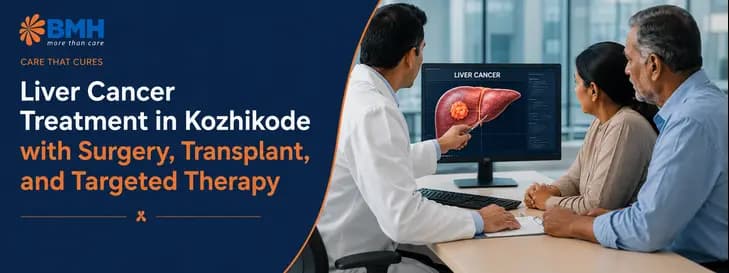

Most people searching for liver cancer treatment in Kozhikode aren't looking for a definition of the disease. They already have a scan report, a biopsy result, or a family member's diagnosis in hand, and one real question: where do I go from here, and what will it actually take, medically and financially.
Liver cancer, also known as hepatocellular carcinoma (HCC), is a serious health concern that affects thousands of Indians each year.
This guide walks you through both surgical and non-surgical approaches, helping you understand what each treatment involves and how specialists decide which path is best for your individual situation.
What is Liver Cancer and Why Treatment Matters
The liver is one of the body's largest and most vital organs, responsible for filtering blood, fighting infection, and managing nutrients. When cancer develops in liver cells, it can spread quickly and interfere with these critical functions. Liver cancer often develops in people with existing liver disease, such as cirrhosis caused by hepatitis B, hepatitis C, or excessive alcohol use.
Early detection through screening is crucial, especially for patients at higher risk. Treatment decisions depend on the cancer stage, the size and number of tumours, liver function, overall health, and whether the cancer has spread beyond the liver.
The Indian Journal of Medical Research emphasises that personalised treatment planning significantly improves survival outcomes. Understanding the available options, surgical removal, tumour ablation, chemotherapy, and newer immunotherapies, empowers patients and families to make informed decisions with their oncology team.
Recognising Liver Cancer Early: Symptoms Patients Often Miss
Roughly 70% - 90% of HCC cases develop on a background of existing cirrhosis, which means early liver cancer symptoms often get attributed to the underlying liver disease rather than investigated as a new problem. Watch for:
- Unexplained upper right abdominal pain or a feeling of fullness under the ribs
- New or worsening jaundice (yellowing of skin/eyes)
- Unintentional weight loss and loss of appetite
- Swelling in the abdomen (ascites) or legs
- Persistent fatigue that doesn't match activity levels
- A palpable lump or hardness below the right rib cage
Who should actually be screened, rather than wait for symptoms:
| Risk group | Recommended screening |
|---|---|
| Cirrhosis of any cause | Ultrasound + AFP blood test every 6 months |
| Chronic hepatitis B carriers (even without cirrhosis) | Ultrasound + AFP every 6 months |
| Chronic hepatitis C, treated or untreated | Ultrasound + AFP every 6 months |
| Diagnosed fatty liver (MASLD) with advanced fibrosis | Discuss surveillance with a hepatologist |
| Family history of liver cancer | Baseline liver evaluation, individualised follow-up |
How Liver Cancer Is Diagnosed Before Treatment Begins
Treatment planning starts with accurate staging, not just a diagnosis. A typical workup includes:
-
Blood tests: liver function panel, AFP (alpha-fetoprotein) tumour marker, hepatitis B/C serology.
-
Triphasic CT or dynamic contrast MRI: the imaging pattern (arterial enhancement with washout) is often diagnostic enough that a biopsy isn't always required.
-
Biopsy: used selectively, when imaging is inconclusive.
-
Staging: most centres use the BCLC (Barcelona Clinic Liver Cancer) system, which factors in tumour size/number, liver function (Child-Pugh score), and the patient's general performance status, not tumour size alone.
-
Multidisciplinary tumour board review: surgical oncology, medical oncology, radiation oncology, hepatology and radiology jointly deciding the treatment path, rather than a single specialist making the call in isolation
This last step is one of the most under-discussed factors in outcomes. A patient with the identical scan report can receive very different treatment recommendations depending on whether the deciding clinician is a surgeon, an oncologist, or a full tumour board, which is exactly why hospital choice matters as much as staging itself.
Liver Cancer Treatment Options Available in Kozhikode
Liver cancer treatment isn't one-size-fits-all. The most effective approach depends on the tumour's size and stage, your liver function, whether cirrhosis is present, and your overall health.
The table below outlines the main treatment options available in Kozhikode and when each is typically recommended.
| Treatment | Best suited for | What it involves |
|---|---|---|
| Surgical resection (hepatectomy) | Single tumour, preserved liver function, no cirrhosis or well-compensated cirrhosis | Removal of the tumour-bearing portion of the liver; can be curative |
| Liver transplantation | Early-stage HCC within Milan criteria (single tumour ≤5cm, or up to 3 tumours each ≤3cm), with underlying cirrhosis | Replaces the diseased liver entirely; addresses both the cancer and the cirrhosis causing it |
| Radiofrequency/Microwave ablation (RFA/MWA) | Small tumours (typically under 3cm) in patients unfit for surgery | Image-guided probe destroys the tumour using heat; minimally invasive |
| TACE (Transarterial Chemoembolization) | Intermediate-stage, multifocal tumours not eligible for surgery | Delivers chemotherapy directly into the tumour's blood supply while blocking it |
| TARE / Y-90 Radioembolization | Intermediate-to-advanced stage, select patients | Delivers radioactive microspheres directly into the tumour's vasculature |
| Radiation therapy (SBRT/Brachytherapy) | Localized disease not suitable for surgery or ablation | Precisely targeted external or internal radiation |
| Systemic therapy (targeted drugs, immunotherapy) | Advanced or metastatic disease | Biomarker-guided drugs or immune checkpoint inhibitors, often combined |
Also Read: Cancer Surgery in Kozhikode: Dr. John J Alapatt on When Surgery Is the Right Choice
No single option is "best" in the abstract, the tumour board decision depends on tumour burden, liver reserve, and overall fitness, which is why a first opinion from a single specialist should generally be treated as a starting point, not a final answer.


Baby Memorial Hospital: Liver Cancer Care in Kozhikode
Liver cancer often develops alongside chronic liver disease, making treatment more complex than simply removing a tumour. Successful care requires specialists who can manage both the cancer and the underlying liver condition. At Baby Memorial Hospital (BMH), this is achieved through the combined expertise of the NAVA Cancer Institute and the Institute of Liver & Gastro Sciences.
Rather than being managed by a single specialist, every liver cancer case is reviewed by a multidisciplinary tumour board. Hepatobiliary surgeons, medical oncologists, radiation oncologists, radiologists, nuclear medicine specialists, and gastroenterologists work together to evaluate imaging, pathology, liver function, and the patient's overall health before recommending the most appropriate treatment plan.
Some of the key strengths of BMH include:
- Integrated liver and cancer care, allowing simultaneous management of hepatocellular carcinoma, cirrhosis, portal hypertension, and other chronic liver diseases.
- Multidisciplinary tumour board discussions that ensure treatment decisions are based on collective specialist expertise rather than individual opinion.
- Comprehensive treatment options including liver surgery, chemotherapy, immunotherapy, targeted therapy, radiation therapy, interventional oncology procedures, and supportive care.
- Advanced imaging and radiation technology, including Discovery IQ PET-CT, TrueBeam LINAC, and GammaMedplus iX Brachytherapy for accurate staging and precision treatment.
- Da Vinci robotic surgical systems, enabling minimally invasive hepatobiliary and oncologic procedures in appropriately selected patients.
Why Patients From Kerala, the Rest of India and the Gulf Choose BMH for Liver Cancer Treatment
If you're comparing hospitals right now, here's the honest version of what that choice usually comes down to for Malabar-region and Gulf-based families:
"Do I need to travel to Kochi, Chennai, or abroad for this?" In most cases, no. The combination of a dedicated liver institute and a full oncology institute under one roof at BMH Kozhikode means diagnosis, staging, tumour board review, surgery or interventional treatment, and follow-up can happen within the same hospital system, without shuttling reports between a gastroenterologist in one city and an oncologist in another.
"Can I actually afford this without going abroad?" Treatment costs at BMH follow the general Kerala/India cost structure outlined above, which runs at a fraction of Gulf, UK or US pricing for the same procedures, a major reason Gulf-resident families increasingly bring liver cases home to Kozhikode rather than treating locally or flying to Europe.
"Will I be treated as a number in a large hospital?" The tumour board model exists specifically so that no single case is decided by one clinician's opinion alone; every liver cancer case is reviewed jointly before a plan is finalised, and BMH's International Patient Services desk supports non-resident and overseas patients with travel, documentation, and coordinated appointment scheduling.
"Is this a 'cancer-only' hospital, or does it understand liver disease itself?" This is arguably BMH's most distinct point for liver cancer specifically: the Institute of Liver & Gastro Sciences and NAVA Cancer Institute function as connected departments, so the cirrhosis or hepatitis driving the cancer is managed by the same institution treating the tumour, not handed off elsewhere.
None of this means every patient's ideal treatment path runs through BMH, it means it's a legitimate option worth a direct consultation before deciding, especially for Malabar-region families who would otherwise default to travelling to Kochi, Bangalore, or the Gulf.
Liver cancer treatment decisions depend on your scan reports, liver function, and overall health, not general information alone. Chat with our care team to get your reports reviewed and understand which treatment path applies to you.
Medical Disclaimer: This article is intended for general informational purposes only and does not constitute medical advice, diagnosis, or treatment recommendations. Liver cancer treatment decisions must be made in consultation with a qualified oncologist or hepatologist based on individual diagnostic reports, liver function, and overall health status. Baby Memorial Hospital and the author do not assume responsibility for decisions made solely on the basis of this content.