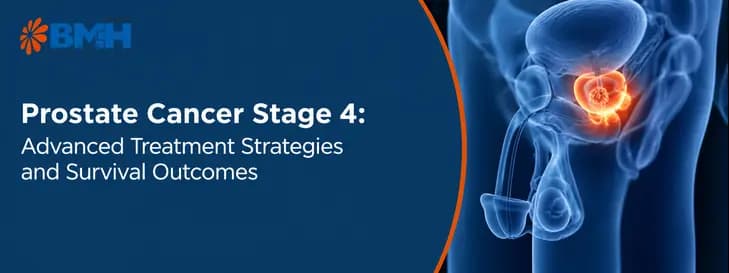

Stage 4 prostate cancer, also called metastatic prostate cancer, means cancer has spread beyond the prostate to other parts of the body. While this is a serious diagnosis, modern treatment strategies have significantly improved survival and quality of life for many patients.
Understanding your options, what to expect during treatment, and how to manage the physical and emotional aspects of advanced cancer can help you and your family navigate this journey with confidence.
This guide walks through what stage 4 prostate cancer is, how it is staged and diagnosed, the treatment options available today, and what advanced multidisciplinary care looks like at a hospital like Baby Memorial Hospital’s NAVA Cancer Institute in Kozhikode.
What Is Stage 4 Prostate Cancer
Prostate cancer is staged using the TNM system, Tumour size, Node involvement, and Metastasis, combined with PSA level and Gleason score/Grade Group, which describes how abnormal the cancer cells look under a microscope.
Stage 4 is the most advanced stage and is split into two sub-stages that genuinely change the treatment conversation:
- Stage 4A: The cancer has grown into nearby structures such as the bladder or rectum, and/or spread to nearby pelvic lymph nodes, but has not travelled to distant organs.
- Stage 4B: The cancer has spread to distant lymph nodes, bones, or other organs such as the liver or lungs. This is what most people mean when they say “metastatic prostate cancer.”
The distinction matters because Stage 4A disease sometimes still allows for combined local treatment (radiation plus hormone therapy), while Stage 4B is managed as a systemic, whole-body disease from the outset.
Early Warning Signs and Symptoms of Stage 4 Prostate Cancer
Many men in their 60s and 70s attribute early symptoms to normal ageing, which is one reason the disease is often caught late. The symptom pattern typically depends on where the cancer has spread.
| Symptom Category | What Patients Notice |
|---|---|
| Urinary | Weak or interrupted urine flow, frequent urination (especially at night), blood in urine |
| Bone-related | Persistent lower back, hip, or pelvic pain; unexplained fractures |
| Systemic | Unintentional weight loss, fatigue, loss of appetite |
| Other | Swelling in the legs (from lymph node involvement), erectile dysfunction, blood in semen |
Bone pain deserves special attention, prostate cancer has a strong tendency to spread to bone before other organs, and persistent pain in the lower back, hips, or pelvis in a man over 50 should prompt a PSA test rather than a painkiller alone.
How Stage 4 Prostate Cancer Is Diagnosed
Diagnosis is rarely a single test, it is a sequence designed to confirm the cancer, grade its aggressiveness, and map exactly where it has spread:
1. PSA blood test: Elevated prostate-specific antigen is usually the first clue, though PSA alone cannot confirm cancer.
2. Digital rectal examination (DRE) and MRI-fusion biopsy to sample suspicious prostate tissue precisely.
3. Gleason score / Grade Group, pathology grading that indicates how aggressively the cancer is likely to behave.
4. PET-CT (often PSMA-based) and bone scan to check whether the disease has spread beyond the prostate, and to how many sites.
At centres with an integrated cancer programme, these results are reviewed jointly by radiologists, pathologists, and oncologists in a multidisciplinary tumour board before a treatment plan is finalised, this joint-review model is increasingly considered best practice for advanced cancer staging rather than having each specialist decide in isolation.
Stage 4 Prostate Cancer Survival Rate: What Indian Data Actually Shows
The 2026 Indian tertiary-centre study referenced earlier followed prostate cancer patients through their full treatment course and found a clear survival gradient by disease extent:
| Disease Extent at Diagnosis | 5-Year Overall Survival |
|---|---|
| Localized (confined to prostate) | 89% |
| Locally advanced | 79% |
| Metastatic (Stage 4) | 41% |
The same study found something equally important for treatment decisions: patients who completed their full course of therapy had a 65% five-year survival rate, compared to just 12% among those with incomplete treatment.


Treatment Options for Stage 4 Prostate Cancer
Stage 4 prostate cancer is treated as a systemic disease, usually with a combination of approaches rather than one single therapy.
1. Androgen Deprivation Therapy (ADT) / Hormone Therapy
Prostate cancer cells rely on testosterone to grow. ADT lowers testosterone levels (through injections or, less commonly, surgical removal of the testicles) and remains the backbone of stage 4 treatment. It does not cure the cancer but can control its growth for a meaningful period.
2. Chemotherapy
Typically added when the cancer no longer responds well to hormone therapy alone, or in cases of high-volume metastatic disease at diagnosis, where combining chemotherapy early with ADT has been shown to improve outcomes.
3. Targeted Therapy and Immunotherapy
Newer oral agents (androgen receptor pathway inhibitors) and, in select cases with specific genetic markers, PARP inhibitors or immunotherapy, are used when the disease becomes resistant to standard hormone therapy, a state referred to as castration-resistant prostate cancer.
4. Radiotherapy; External Beam and Brachytherapy
Radiotherapy is not only for early-stage disease. In stage 4, external beam radiation (IGRT/IMRT/VMAT) can shrink the primary tumour and relieve pain, while high-dose-rate (HDR) brachytherapy delivers concentrated radiation from within, sparing surrounding healthy tissue. Radiation to individual bone metastases is also commonly used purely for pain relief.
Role of Surgery and Minimally Invasive Procedures Radical prostatectomy is uncommon once the disease has spread, but minimally invasive procedures such as TURP (transurethral resection of the prostate) may still be used to relieve urinary blockage and improve quality of life, even when they are not curative.
| Treatment | Primary Purpose | Typical Setting |
|---|---|---|
| ADT / Hormone therapy | Slow cancer growth long-term | First-line, most stage 4 patients |
| Targeted therapy / immunotherapy | Address castration-resistant disease | After hormone therapy stops working |
| External beam radiotherapy | Shrink tumour, relieve bone pain | Primary tumour or symptomatic metastases |
| HDR brachytherapy | Precise internal radiation to the prostate | Combined with hormone therapy in select 4A cases |
| TURP / minor surgery | Relieve urinary symptoms | Symptom management, not curative |
Why NAVA Cancer Institute at Baby Memorial Hospital Is a Trusted Choice for Advanced Prostate Cancer Care
If your family has just been told that prostate cancer is stage 4, choosing the right hospital becomes one of the most important decisions you'll make. Advanced prostate cancer rarely depends on a single treatment. It often requires a carefully coordinated approach involving medical oncology, radiation oncology, urology, diagnostic imaging, and pathology. The quality of communication between these specialists can significantly influence how quickly treatment begins and how well it is tailored to the patient's condition.
At NAVA Cancer Institute, Baby Memorial Hospital (BMH), Kozhikode, complex prostate cancer cases are reviewed through a multidisciplinary tumour board, where specialists jointly evaluate imaging, pathology, staging, and treatment options before a personalised care plan is finalised.
Key strengths of BMH for advanced prostate cancer care include:
1. Multidisciplinary cancer care: Medical oncologists, radiation oncologists, urologists, radiologists, and pathologists collaborate to develop an evidence-based treatment plan rather than working independently.
2. Advanced radiation therapy under one roof: Led by Prof. Dr. P. R. Sasindran, the Radiation Oncology department offers:
- TrueBeam Linear Accelerator for advanced external beam radiotherapy (IMRT, IGRT, VMAT).
- GammaMedplus iX HDR Brachytherapy for internal radiation therapy when clinically appropriate.
3. Experienced prostate urology team: BMH has demonstrated expertise in advanced prostate procedures. In June 2026, its Dr. H&K Urology team performed UroLift, iTIND, Rezūm, and HoLEP procedures in a single day, reflecting extensive experience in managing complex prostate conditions.
4. Comprehensive diagnostic and staging facilities: Accurate staging is essential for stage 4 prostate cancer. BMH provides advanced imaging on-site, including:
- Discovery IQ 3-Ring PET-CT
- Wide-bore 1.5T MRI
- 128-slice CT scanner
Having these services within the hospital allows diagnostic work-up and treatment planning to proceed without delays caused by referrals to external imaging centres.
5. Support for international and out-of-state patients: Dedicated international patient services assist with medical appointments, travel planning, accommodation, interpreter support when required, and treatment scheduling. Patients also receive transparent treatment estimates to help them plan their care in advance.
Living With Stage 4 Prostate Cancer; Managing Symptoms and Quality of Life
Treatment doesn’t stop at drugs and radiation. For most stage 4 patients, quality of life depends just as much on:
- Pain management: a combination of medication and targeted radiotherapy to painful bone sites
- Bone health: bone-strengthening medications to reduce fracture risk, since bone is the most common site of spread
- Nutrition: maintaining muscle mass and weight during long treatment courses
- Mental health support: anxiety and depression are common and under-discussed after an advanced cancer diagnosis; psycho-oncology support is increasingly offered alongside physical treatment
- Caregiver involvement: families managing a Gulf-to-Kerala treatment journey benefit from having a single care coordinator rather than juggling multiple departments independently.
If you or a family member has recently been diagnosed with stage 4 prostate cancer, you don’t have to work through the next steps alone. Chat with our care coordination team to get help understanding your reports, request a second opinion, or plan a consultation at NAVA Cancer Institute, Baby Memorial Hospital, including support for scheduling and travel if you’re contacting us from outside Kerala.
Medical Disclaimer This article is intended for general informational purposes only and does not constitute medical advice, diagnosis, or treatment recommendations. Prostate cancer staging, prognosis, and treatment decisions vary significantly from patient to patient and must be made in consultation with a qualified oncologist or urologist based on individual test results and health history. If you or a loved one are experiencing symptoms of prostate cancer, please consult a healthcare professional promptly.